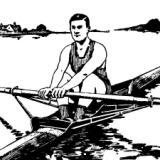
The Boat Race between Oxford and Cambridge is known for its brothers, even twins, sitting in the same boat, or fighting each other, one rowing for the dark blues and the other one rowing for the light blues. In the race tomorrow, the two Americans Cameron and Tyler Winklevoss are both rowing for Oxford. In the rowing world they might be known as Olympians who placed sixth in the pairs in Beijing in 2008. For the non-rowers they might even be more famous as the twins who sued Facebook. Read here an article about the brothers and their involvement in an upcoming film this autumn, The Social Network, about the founding of Facebook, but there will also be some rowing in the movie, of course.
Wednesday, March 31, 2010
The Winklevosses To Face Cambridge
The Boat Race between Oxford and Cambridge is known for its brothers, even twins, sitting in the same boat, or fighting each other, one rowing for the dark blues and the other one rowing for the light blues. In the race tomorrow, the two Americans Cameron and Tyler Winklevoss are both rowing for Oxford. In the rowing world they might be known as Olympians who placed sixth in the pairs in Beijing in 2008. For the non-rowers they might even be more famous as the twins who sued Facebook. Read here an article about the brothers and their involvement in an upcoming film this autumn, The Social Network, about the founding of Facebook, but there will also be some rowing in the movie, of course.

Phew...
 March has been an interesting month. Looking back, I realise that I have managed to post at least one entry a day, or, including this one, forty-three entries for the whole entire month. Phew, a little exhausting, if I may say so myself. However, I have had some great help from some readers of the blog, to mention this month’s ‘assistants’: Malcolm Cook, John Eade, Philip Kuepper, Chris Partridge, and, of course, Hélène Rémond and Tim Koch. Thank you very much for your valuable input, comments and contributions. Keep them coming! I already know that April is going to be a busy month for me; I have to wrap up some articles for Rowing & Regatta and the Swedish rowing magazine Svensk Rodd, and some other small pieces here and there. A trip to Sweden will also make it impossible to keep on posting an entry a day. Please be patient…
Tuesday, March 30, 2010
Rowing School Girls In The 1950s
 Already in another entry (Rowing Books For Youths 1, on 7 August 2009), I have talked about the Amalgamated Press, which for several years published magazines for girls and boys. This publishing company, which also published books under the names Fleetway Publications and Fleetway House (as it was located in Fleetway House in London), also came out with juvenile ‘annuals’. The School Friend Annual
  started in 1927 to entertain girls with cartoons, strips, poems, articles, stories, and fashion, etc. In 1953 and 1959, the covers of The School Friend Annual show girls in a rowing setting. While both pictures are ‘nice’, artistic improvements could have been made to the details of the boats. Now, the riggers go right into the hull (1953) and the sculling girl in the single is using terribly ‘thin’ sculls (1959).
Monday, March 29, 2010
The Hierarchy Of Blazers At Henley Royal
To be really honest I expected Tim Koch to come back to me with a reaction to my entry …And A Dress Faux Pas from yesterday, and he did. He writes that he had a busy weekend with coxing the Head of the River (400 boats) on Saturday and the Veterans’ Head of the River (200 boats) on Sunday. Tim writes “It’s the Boat Race next weekend, I will not be coxing(!) but I will be selling lots of beer.”
About my suggestion that he should start a ‘well dressed oarsmen and women blog’, he finds it “an interesting one, but I'm not sure there is enough material. Most of the world seems to want to dress like teenage skateboarders.” How true this is. My son is not there - yet. Last spring, when my family and I were visiting the ‘fancy’ children’s clothing store in Mystic, he got the idea that he wanted a tie. Very happily I agreed and allowed him to pick out one. He picked out a stylish yellow tie with dinosaurs which maybe would not be my first choice, but on the other hand he is only four…
 Back to Tim, who, on the topic of my thoughts about the brown-coloured plaid jacket and the brown hat that a fellow is wearing in the ‘Henley picture’ from yesterday, states that, “The now inactive rowing blog, the Tideway Slug, holds that, as in most things in British rowing, there is a hierarchy of blazers at Henley Royal:
Senior International or Olympic
Under 23 and Junior International - only if the date on the pocket is less than 5 or more than 25 years ago
Oxford/Cambridge full rowing Blue
Leander Club
Top rowing club, university or school - usually means a club with recent Henley wins
Navy blue blazer but with tie representing any of the above
Oxford/Cambridge half rowing Blue
Other rowing school or university
Low performance rowing club
Plain navy blue with low performance club tie
Non-rowing related blazer with an embroidered pocket – if it’s not for rowing we’re not impressed
Any navy blue store brand with indiscriminate non-rowing tie.
Garishly coloured ‘fashion’ blazer
Anything in tweed
A Suit
and so far the Tideway Slug.”
 Tim does not share my opinion about the plaid jacket at Henley Royal. “However, at the time the picture was produced (1930s?), the gentleman in the plaid jacket would not have stood out,” Tim notes. He quotes, Alan Flusser, who in his book Dressing The Man (Harper Collins, 2002) states: “The post-war obsession with sports and outdoor activities encouraged fashion experimentation.... By the latter part of the twenties, the (tweed shooting jacket), trimmed of its countrified detailing and worn with separate trousers in contrasting fabrics such as flannel or gabardine, became the ideal expression of casual elegance for competitors and spectators alike.”
“On British Pathé,” Tim writes “there is this short film of Henley in 1938 which shows several men in the everyday lounge suits and trilby hats of the time”:
Tim finished up today’s entry by saying that “In my last posting [on Friday 26 March] I was very rude about Americans wearing Tuxedos during the day. To be fair to our Transatlantic Cousins, U.S. school and university crews at Henley are usually amongst the smartest people attending. (Apart from their shoes - and baseball caps.) Also it must be admitted that (arguably) incorrect formality is better than not trying at all. Was it Woody Allen who said that, in California, ‘formal’ means long pants?”
Thank you Tim for yet another enjoyable entry!
About my suggestion that he should start a ‘well dressed oarsmen and women blog’, he finds it “an interesting one, but I'm not sure there is enough material. Most of the world seems to want to dress like teenage skateboarders.” How true this is. My son is not there - yet. Last spring, when my family and I were visiting the ‘fancy’ children’s clothing store in Mystic, he got the idea that he wanted a tie. Very happily I agreed and allowed him to pick out one. He picked out a stylish yellow tie with dinosaurs which maybe would not be my first choice, but on the other hand he is only four…
 Back to Tim, who, on the topic of my thoughts about the brown-coloured plaid jacket and the brown hat that a fellow is wearing in the ‘Henley picture’ from yesterday, states that, “The now inactive rowing blog, the Tideway Slug, holds that, as in most things in British rowing, there is a hierarchy of blazers at Henley Royal:
Senior International or Olympic
Under 23 and Junior International - only if the date on the pocket is less than 5 or more than 25 years ago
Oxford/Cambridge full rowing Blue
Leander Club
Top rowing club, university or school - usually means a club with recent Henley wins
Navy blue blazer but with tie representing any of the above
Oxford/Cambridge half rowing Blue
Other rowing school or university
Low performance rowing club
Plain navy blue with low performance club tie
Non-rowing related blazer with an embroidered pocket – if it’s not for rowing we’re not impressed
Any navy blue store brand with indiscriminate non-rowing tie.
Garishly coloured ‘fashion’ blazer
Anything in tweed
A Suit
and so far the Tideway Slug.”
 Tim does not share my opinion about the plaid jacket at Henley Royal. “However, at the time the picture was produced (1930s?), the gentleman in the plaid jacket would not have stood out,” Tim notes. He quotes, Alan Flusser, who in his book Dressing The Man (Harper Collins, 2002) states: “The post-war obsession with sports and outdoor activities encouraged fashion experimentation.... By the latter part of the twenties, the (tweed shooting jacket), trimmed of its countrified detailing and worn with separate trousers in contrasting fabrics such as flannel or gabardine, became the ideal expression of casual elegance for competitors and spectators alike.”
“On British Pathé,” Tim writes “there is this short film of Henley in 1938 which shows several men in the everyday lounge suits and trilby hats of the time”:
HENLEY REGATTA
Tim finished up today’s entry by saying that “In my last posting [on Friday 26 March] I was very rude about Americans wearing Tuxedos during the day. To be fair to our Transatlantic Cousins, U.S. school and university crews at Henley are usually amongst the smartest people attending. (Apart from their shoes - and baseball caps.) Also it must be admitted that (arguably) incorrect formality is better than not trying at all. Was it Woody Allen who said that, in California, ‘formal’ means long pants?”
Thank you Tim for yet another enjoyable entry!
Sunday, March 28, 2010
...And A Dress Faux Pas
 I am not really ready to let go of Tim Koch’s theme ‘rowing history and men’s classic clothes’ yet. You see, I happened to find two old images from the magazine Esquire on the web, that both are in a ‘rowing setting’. I do not know how old these pictures are, but I am guessing that they are between 50 and 70 years old. In the picture from the Henley Royal Regatta (at the top), we see some spectators (the course is in the background with some boats) dressed in bright-coloured jackets and the striped jackets that are all over this regatta still to this day. I do not believe, however, that you nowadays would ever see a visitor at Henley Royal wearing a brown-coloured plaid jacket like the fellow off centre to the right, nor, actually, wearing a brown hat of that fashion.
 The second image (on the left) shows two well-dressed gentlemen in the foreground of a boathouse from which some oarsmen are getting ready to launch their shell. The man holding an oar is wearing an over-coat that I have not seen anyone wearing ever (is there in fact anyone wearing an over-coat these days?). The man on the right is dressed in a plaid suit that I would not dare to put on, just because I am not that brave. His suede shoes look elegant and do match his suit, though; I do have ‘the courage’ to wear suede shoes. I once bought a pair of brown suede shoes in Paris (together with a blue knitted tie, but that is another story). How I loved these shoes. It was only a couple of years ago I threw them out, although they were over-due long ago. The second image states who the artist is that did the illustration: Stewart Heidgerd. I googled him and saw that Heidgerd did art work for Esquire (which was first published in 1933), during the late 1930s, maybe even later.
 I cannot help pointing out one thing in Tim’s eminent article on the well-dressed Wingfields’ winners’ dinner that made my heart skip a beat. For when Tim writes that “only Americans and waiters wear black tie during the day”, I was painfully reminded that a friend of mine showed up in ‘black tie’ to my dear wife’s and my wedding, which was held ten years ago in Sweden, at noon. Of course, I was wearing morning dress (for those of you readers that think that this is a nicer name for a man’s pyjamas, please look at the image on the right). So, Tim, not only Americans and waiters, even some Swedes are wearing black tie during the day, I am sorry to say…
Saturday, March 27, 2010
The 156th Boat Race
 A week from today, Saturday 3 April, it is time for the Boat Race between Oxford and Cambridge on the Thames again. Last year Oxford won. The best site to get information about the crews, the course, the race history, where to view the race, and crew video diaries, etc is the official site, www.theboatrace.org/. The promotion video, the Xchanging Boat Race 2010 Promo, as it is called, featuring old Blue, Olympic and World champion Matthew Pinsent, can be viewed below.
Wingfield Sculls Centenary Dinner Menu
 Autobiographer Vivian Nickalls, Wally Kinnear, and Bill of Fare composer, Guy Nickalls.
Here is a little foot note to the wonderful story Tim Koch provided about the Wingfield Sculls Centenary Dinner which was posted yesterday. In Vivian Nickalls’s autobiography Oars, Wars, and Horses – how I love this title – which was published in 1932, Nickalls mentions this dinner (pages 42-45) and the Bill of Fare which was composed by his brother, Guy Nickalls. It is really an oarsman’s menu,
 “THE START with WHERRY – good OAR d’Oeuvres NO CRABS included – soup TURN TURTLE – fish SOLES PRESSED (against the stretcher) – Cutlets supreme with CUTTERS (far astern) – NO FOWLS Pheasants with NO FEATHERING – THE STARTERS – Peches TO Melba – BEST and BEST BOAT Ice – Last Course – CHAMPION CHAMPIGNONS with a HARD ROW Over. Wines without Whines – Champagne – Real Pain for those on Fixed Seats Only – Port – Starting Always On The Port Side.”
 Vivian Nickalls writes that three more Wingfields’ winners were invited to the dinner, but F.L. Playford was very ill, and both A.A. Stuart and A.H. Cloutte were abroad at the time of the dinner. Nickalls seems to have collected the autographs of the fourteen men present (Above; observe the charming little drawing of a sculler after Harry Blackstaffe’s name!).
“THE START with WHERRY – good OAR d’Oeuvres NO CRABS included – soup TURN TURTLE – fish SOLES PRESSED (against the stretcher) – Cutlets supreme with CUTTERS (far astern) – NO FOWLS Pheasants with NO FEATHERING – THE STARTERS – Peches TO Melba – BEST and BEST BOAT Ice – Last Course – CHAMPION CHAMPIGNONS with a HARD ROW Over. Wines without Whines – Champagne – Real Pain for those on Fixed Seats Only – Port – Starting Always On The Port Side.”Vivian Nickalls writes that three more Wingfields’ winners were invited to the dinner, but F.L. Playford was very ill, and both A.A. Stuart and A.H. Cloutte were abroad at the time of the dinner. Nickalls seems to have collected the autographs of the fourteen men present (Above; observe the charming little drawing of a sculler after Harry Blackstaffe’s name!).Friday, March 26, 2010
Presentation Of The 2010 Rowing Hall Of Fame Inductees
 Photograph by Andy Price
Today the National Rowing Foundation (NRF) posted a wonderful presentation of quotes and sayings about and by the 2010 Rowing Hall of Fame Inductees. The presentation is compiled by NRF Shield Fellows Lindsay Shoop and Dan Walsh. Read it by clicking here.
The Rowing English Gentleman
 In a message regarding a previous entry on my blog, Tim Koch of Auriol Kensington RC in London has some entertaining comments: “Your recent posting, ‘An Oarsman’s Dress Code’, included two of my interests: rowing history and classic men’s clothes. The archive at Auriol Kensington nicely illustrates how men’s formal dress changed during the Twentieth Century. The splendid picture ‘Wingfield Sculls of the
  Thames’ [above] shows a dinner given by the Earl of Iveagh (Rupert Guinness) held at his house, 11 St James’s Square, on 11th December 1930 for past winners of the Wingfield Sculls (The English Amateur Sculling Championship). Those present, to commemorate the centenary of this race, were Iveagh, Guy Nickalls, Rev. W.S. Unwin, F.I. Pitman, Vivian Nickalls, J.L. Tann, T.D.A. Collet, H.D. Blackstaffe, D.Guye, J.C. Gardner, J. Beresford [Jr.], Rev. A.C. Dicker, C.W. Wise, and W.D. Kinnear. All are resplendent in ‘white tie’, which is a tailcoat, white waistcoat (vest) and dress shirt with a stiff bib front, high-standing wing collar and white bow tie. Even Kinnear and Blackstaffe, men much lower on the social scale than the rest of the group, are in the correct dress. They are all wearing their Wingfield Medals, each with a bar on the ribbon denoting the year(s) in which they won.” [Have a look on the right at the stylish Jack Beresford, Jr., and his seven bars for his Wingfields' victories between 1920-1926].
 On this fascinating topic Tim continues, “Though taken in 1930, the picture is more illustrative of a formal gathering before the 1914-1918 War. The picture ‘KRC Dinner 1933’ [above] shows the
  mixture of ‘white tie’ and ‘black tie’ (a.k.a. ‘dinner jacket’ or ‘dinner suit’ or ‘tuxedo’) that would have been common in the inter war years. The dinner jacket had been invented in the 1870s by the Prince of Wales (later King Edward VII, 1901-1910) for informal dining at home. Its essence was a tailless jacket and soft shirt with a turned down collar and black bow tie. By the 1930s the Duke of Windsor (briefly King Edward VIII) and his set were wearing the more comfortable outfit in public and it began to replace the tailcoat. ('DOW' in 'DJ' on the right.) Since the 1939-1945 War, white tie is only seen on the most formal of state occasions. In the 1960s and 1970s it looked as though black tie would also drift into oblivion but, by the time I started to attend rowing club dinners in the mid 1980s,
  the ‘DJ’ was back and is now worn by the vast majority of men at formal evening functions. I do mean ‘evening’, only Americans and waiters wear black tie during the day. At Auriol Kensington, those of us with regatta blazers sometimes follow the Oxford and Cambridge custom of wearing them in place of the traditional jacket with our dinner suits. On the left is a picture of me in such a rig,” Tim concludes.
Tim, this was very entertaining. Thank you! Maybe time for you to start a blog on well-dressed oarsmen and oarswomen?
Thursday, March 25, 2010
The Rower Of Light
 I find it relaxing to read poems. Here is another one by local poet Philip Kuepper. Enjoy!
The Rower of Light
The rower had come to the river,
For the river had come to him,In a dream. In his shell,
On the river, he was oneWith the river, one with the motion
Of his rowing. Out,In the center of the river, light
Lay a path the rowerCould row with, a current
Of light that took the rower to depths,Without his leaving the surface.
He had rowed away, from shore,Rowed away, from the world.
He rowed away, from his body,Flesh and bone,
Until he reached the point
Where his being was.
Philip Kuepper(2008)
Wednesday, March 24, 2010
Books At The Rowing History Forum


During the lunch break and at the reception at Sunday’s Rowing History Forum the attendees could take the opportunity to buy some rowing books from the participants, who had written rowing books, and of course get them signed by the authors. Two of the titles have been around for some years, Beauty and the Boats (2005) by Tom Weil and Ernestine Bayer: Mother of U.S. Women’s Rowing (2006) by Lew Cuyler, but if you have not seen these titles before, here was the chance to get your copy with a personal inscription.
 A brand new book on rowing is An Obsession with Rings – How Rowing Became an Olympic Sport for Women in the United States by Joanne Wright Iverson (with Margaret O. Kirk), published in 2009. Wright Iverson, newly elected president of Vesper Boat Club in Philadelphia, began to row at the Philadelphia Girls’ Rowing Club (PGRC) in 1959. She immediately got hooked and one year later she won her first trophy. Together with Ted Nash and Ed Lickiss, the three of them founded the National Women’s Rowing Association (NWRA) in 1963, which led to the National NWRA Championship Regatta in 1966. A year later Wright Iverson was coaching women instead of rowing herself. In 1976, she would see her dream come true, women competing in rowing at the Olympic Games. (If you would like to order a copy of Joanne Wright Iverson’s intriguing book, please click here.)
 I was also lucky to meet ‘Dr. Rowing’ (a.k.a. Andy Anderson) at the Forum. He was kind enough to bring me a copy of his eminent and enjoyable book The Compleat Dr. Rowing (2001), which is a collection of questions and answers from ‘Dr. Rowing’s’ famous column in Rowing News. Reading his book shows what we have known for a very long time: ‘Dr. Rowing’ is a funny fellow.
An Interesting And Smooth Running Forum
 The grand National Rowing Hall of Fame Inaugural Induction Ceremony on Saturday 20 March, was followed by a Rowing History Forum on Sunday 21 March with around 70 attendees. This, the 5th Rowing History Forum, was organised by Friends of Rowing History, National Rowing Foundation, Mystic Seaport Museum, and American Friends of the River & Rowing Museum. Just as previous Forums, participants came from near and far, from both the American east coast and the west coast, and everywhere in between.
 The two who had travelled furthest to get to Mystic were Terry Morahan and his daughter, Rosa, from Belfast in Northern Ireland. With the help of Rosa's technical skills, Terry Morahan, an oarsman at Belfast RC and a rowing historian, delivered an interesting talk called To the Land of the Free and the Home of the Brave from the Land of the Saints and Scullers about how the first Leander medal at the Grand at Henley ended up in a thrift-shop in Ireland. Mr. Morahan’s talk was actually the last of the day. First out in the morning was the famous rowing historian Tom Weil, who talked about the Doggett’s Coat and Badge Race, and thereafter it was special guest speaker Kent Mitchell's (seen on the right) turn to give his very entertaining talk, which had the striking title Surviving Five Years as Conn Findlay’s Coxswain.
 After a short lunch break, renowned Chris Dodd, consulting rowing historian at the River & Rowing Museum in Henley-on-Thames (seen on the left), gave a talk called Twenty Years without the DDR, which dealt with how the fall of the Berlin wall in 1989 changed everything, not only for the East-German rowers and coaches, and FISA, but for world rowing. Allegations, especially from Americans (it also happened in the room after Dodd’s talk), have been raised that the East-German rowers, both men and women, took banned substances to achieve better results on the rowing course, but according to Dodd, no rowers from East-Germany were ever caught doing so. DDR’s representative in FISA, knew how utterly strict the federation was in this matter. I found Dodd’s presentation extremely interesting.
After Dodd, came Bill Miller, who is running the marvellous web site Friends of Rowing History (www.rowinghistory.net/), and who is the coordinator of these history forums in the U.S. Miller’s talk was about one of his special interests, rowing patents. His talk, titled 19th Century Rowing Patents, made many of us realize that nothing is new under the rowing sun. Already in the late 1800s, patents were filed for front-rowing, the sliding-rigger, syncopated rowing, and other inventions that we might think are new – not so, they might be innovations, not inventions. Of course, Miller also showed some laugh-out-load funny patents, like the ‘flying air-single’ and the ‘single on tracks’, with which you should be able to row around your large estate on land-based tracks. It was as Bill Miller said, “What were they thinking?”
 Bill Lanouette and Chris Dodd in front of the Doggett's Coat.
 The Rowing History Forum ended with a nice reception and a tour of the Rowing Hall of Fame and the exhibit ‘Let Her Run’, lead by Tom Weil (in picture on the right), who has donated around 90 percent of what is now in the exhibit's show cases. Everything first class stuff - just as this Forum! Hart Perry (on the left) was very happy at the end of the day, not only had the Rowing Hall of Fame party the previous day been a huge success, the Sunday Forum had gone smoothly, too. Two great events!
Tuesday, March 23, 2010
Beer - A Great Help To Crews In Training?
My earlier posting about Brakspear’s ale, triggered Tim Koch to send me a message with a superb Brakspear ad. Tim writes “Your postings on rowing and alcohol prompt me to send a picture of the advertisement from the 1928 edition of the Oarsmans Companion on display in the Auriol Kensington RC ergo room. I like the idea that oarsmen in training should only drink the purest beer. It reminds me of the old advertising by-line for ‘Craven A’ cigarettes which urged you to smoke them ‘For Your Throats Sake’.”
 It is a great ad, I must say. I remember in 1991 when I was at an international regatta at Gladsaxe Rostadion, Lake Bagsværd, outside of Copenhagen. In between heats, I saw the members of the Australian coxless four relaxing, playing ping-pong and drinking beer. This was an hour before they went out to easily win the final. A couple of weeks later, they became the world champions in the coxless four in Vienna, Austria.
I like to believe that the Danish beer the Australian fellows drank had something to do with their success that year.
It is a great ad, I must say. I remember in 1991 when I was at an international regatta at Gladsaxe Rostadion, Lake Bagsværd, outside of Copenhagen. In between heats, I saw the members of the Australian coxless four relaxing, playing ping-pong and drinking beer. This was an hour before they went out to easily win the final. A couple of weeks later, they became the world champions in the coxless four in Vienna, Austria.I like to believe that the Danish beer the Australian fellows drank had something to do with their success that year.
Oh, What A Swell Party It Was!
 On Saturday evening, 20 March 2010, the National Rowing Foundation (NRF), the governing body of the National Rowing Hall of Fame, inducted eighteen new members into ‘The Hall’. It was, as NRF’s Executive Director Hart Perry put it, “an historic occasion [as it was] the first time in its 54-year existence that the National Rowing Hall of Fame has hosted a stand-alone induction ceremony.” And what a ceremony it was! 253 people had gathered to honour, celebrate, and cheer on the Inductees when they received their certificates from the hands of Hart Perry, who this evening saw a dream come true.
The Inductees were (click here to get a presentation of their achievements; and their presenters are in parenthesis): James W. Dietz (Bill Miller); Anne Marden Grainger (Barb Kirsch); Karen Rigsby and Missy Schwen Ryan (Larry Hough); Thomas Bohrer, who was not present due to an accident (Ted Nash); Amy Fuller Kearney (Mary Whipple); the late Andrew Sudduth (Harry Parker); Anita DeFrantz (Paul Fuchs); Michael F. Teti (Kris Korzeniowski); the 2004 Athens Olympic Men’s Eight: Jason Read, Wyatt Allen, Christian Ahrens, Joseph Hansen, Matthew Deakins, Daniel J. Beery, Beau Hoopman, Bryan Volpenhein, and coxswain Peter M. Cipollone (Michael Teti).
 The festivities began with a reception party at the Rowing Hall of Fame in the G.W. Blunt White Building (where the grand rowing exhibit ‘Let Her Run’ is also located) at Mystic Seaport Museum in Mystic, Connecticut. ‘Blunt White’ quickly became crowed. And ‘everybody’ in the U.S. rowing community seemed to be there and nicely dressed-up, too (I actually saw a couple of dinner jackets/tuxedos). They were having a good time. The weather gods were working well with the organisers and the sun was shining from a cloud-free sky on those who preferred to be outside.
 At 7:00 p.m. the banquet with the ceremony started at the museum’s restaurant across the way from ‘The Hall’. Hart Perry welcomed all, and the ceremony began with the oldest Inductee. Jim Dietz (born in 1949; seen in the photo on the right) was introduced and awarded his certificate. And then it rolled on. There were many touching, moving, and funny talks delivered by both the presenters – and here maybe the coaches Ted Nash’s and Kris Korzeniowski’s speeches stood out – and by the Inductees. All the Inductees got standing ovations both when they approached the podium and after they had received the certificates that proved that they now belonged to an extraordinary group of American sportsmen and sportswomen.
 With a dozen or so members of the Rowing Hall of Fame present and the eighteen Inductees, someone pointed out that never before, counting Olympic and World Championship rowing medals, had that many prominent American oarsmen and oarswomen been gathered at one single event. This was not hard to believe, because wherever one turned there were old and more recent champions and their famous coaches chatting or sipping a drink or two.
At the banquet I was lucky ending up at the 'rowing historian table', with well-known scholars like Chris Dodd, William Lanouette, Peter Mallory, Bill Miller (seen on the left), and Tom Weil.
It was a wonderful evening!
Monday, March 22, 2010
Guinness's Rowing Ads
Regarding my entry about Brakspear's Henley Ale on 20 March, one of my blogs loyal readers and contributors, Hélène Rémond, writes in a comment, that "Guinness has also used rowing images to advertise its brand. I have found two Guinness ads published in the British Rowing Almanack in 1953 and 1954, which read 'Have a glass of Guinness when you're tired' and 'Lovely day for a Guinness'. One features a sculler which would regain his strength by drinking a pint and the other infers that Guinness suits the rower who wants to take the lead. The mascot of the brand, the toucan, acts as cox of the crew. A third one appeared in a document published in 1981 by the London Rowing Club celebrating its 125 years of rowing with the following caption : 'Row of Guinness', reminiscent of the blades slicing the water in harmony." Great contributions, Hélène, many thanks!


Subscribe to:
Posts (Atom)